

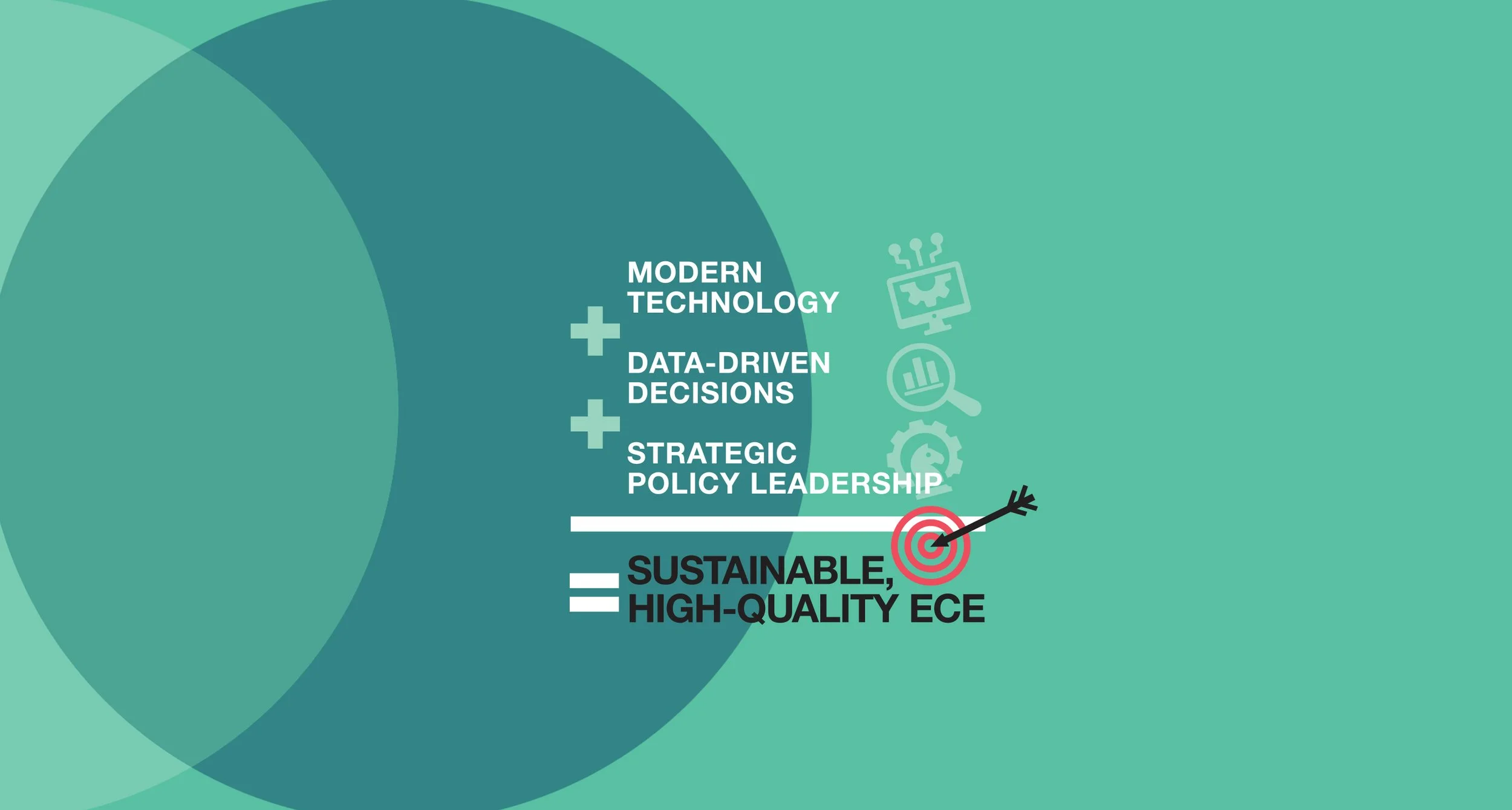

Our Focus

Modern
Technology.
What if every ECE provider had access to user-friendly technology that made daily operations easier while also generating the data needed to inform teaching, learning, and business decisions?
Automated systems such as mobile banking, Google Maps and GPS navigation, pay-at-the-pump, and real-time weather forecasts have become routine parts of our daily lives. These tools do more than streamline our experience as consumers—they also generate valuable data to understand patterns, make informed decisions, and plan for the future.
Yet many child care programs still rely on paper-based processes and spend countless hours completing, filing, and managing forms; documenting compliance; verifying records; and processing applications that are often mailed or delivered by hand. While many child care consumers are digital natives who expect convenient electronic payment options, some providers still require cash or checks and lack automated systems for managing finances. These outdated practices can unintentionally contribute to late payments, growing bad debt, and persistent cash-flow challenges.
In short, the ECE field has not yet fully harnessed the power of automation to manage routine administrative tasks. Site directors often spend too much time on paperwork—or too much money hiring administrative staff to manage it for them. That is time and money that could instead support teaching and learning, staff supervision, family engagement, and the many other real-world challenges that deserve focused attention.
This is a problem with a clear and achievable solution. Affordable technology solutions already exist, and new applications are being developed every day. OppEx is focused on gathering and sharing vendor-neutral information to help the ECE sector understand, evaluate, and adopt state-of-the-art technology that can reduce administrative burdens, strengthen business operations, and ultimately create more time and capacity for what matters most.

Data Driven
Decisions.
Automation can save time and money by replacing routine administrative tasks, but a greater value is its ability to generate and analyze information that informs better decisions. Child Care Management Software (CCMS) can give providers real-time data to guide everyday operations—from enrollment and staff development requirements to family payments and cash flow. That same data can also inform pedagogy, helping educators better understand the factors that influence teaching and learning.
Aggregated CCMS data can answer critical questions about the ECE system: How many child care seats are available today in a particular city, state, or ZIP code, regardless of provider type, funding stream, or licensing status? Where is there an oversupply of care for four-year-olds and an undersupply of infant care? Where are workforce or capacity gaps emerging?
When securely aggregated without personally identifying information, CCMS data can also inform policies and investments related to teacher preparation and compensation, child transitions, quality improvement, and access to care. In this context, data becomes a tool for understanding and strengthening the ECE system—not simply another reporting requirement.
To realize this potential, OppEx is focused on enabling data bridges between provider systems such as CCMS and public systems that administer child care and pre-K subsidies, CACFP, licensing and quality, professional development, child care search, and other essential functions. Connecting these systems can provide a more real-time picture of ECE and help providers, communities, and policymakers make better-informed decisions about resources and priorities.

Strategic Policy Leadership.
Innovation in automation, business models, and data-driven administration often requires policy to evolve alongside it. Even well-intentioned policies can constrain innovation when they are not revisited as technology, practices, and needs change.
OppEx focuses on the intersection of innovation and policy, partnering with government and industry leaders to identify, develop, and advance policies that enable meaningful change. Through data analysis, consultation, case studies, issue briefs, podcasts, peer learning groups and other tools, we develop and track policy solutions, evaluate their impact, and share lessons learned to help accelerate effective innovation across the ECE sector. While OppEx maintains a focus on harnessing the power of modern technology, we are also engaged in strategies to rethink the traditional child care business model and explore new business models such as micro-centers, simplify and ‘right-size’ child care licensing, re-tool Child Care Resource and Referral agencies to include effective business coaching acumen in their portfolios, and more.